
How to Make Your CV Clearer, Stronger and Easier to Share
Most CVs don't get read word for word.
Recruiters and hiring managers often scan a CV quickly, looking for the information that tells them whether a candidate is relevant. That means your first priority shouldn't be clever design or complicated wording.
It should be clarity.
A good CV should make it easy to understand who you are, what you do, what you've accomplished and how to contact you.
Here are a few simple changes that can make a big difference.
1. Start With a Clear Summary
Your summary is often one of the first things someone sees.
Instead of filling it with adjectives like hardworking, passionate, motivated and results-driven, use one clear sentence to explain what you actually do and who you do it for.
For example:
"Digital marketer helping small businesses grow through social media, content and paid advertising."
That tells the reader much more than a paragraph describing your personality.
Your summary should quickly answer three questions:
- What do you do?
- What area do you specialize in?
- Who or what do you help?
Keep it short and specific.
2. Make Your Timeline Easy to Scan
Recruiters shouldn't have to search through a paragraph to figure out when you worked somewhere.
Keep your employment dates consistent throughout the CV and place them in the same position for every role.
For example:
Marketing Manager
ABC Company | Nairobi, Kenya
2023 – Present
Marketing Assistant
XYZ Agency | Nairobi, Kenya
2021 – 2023
This creates a visual pattern that allows someone to understand your career timeline almost immediately.
Consistency matters more than complicated formatting.
3. Don't Include Every Job You've Ever Had
A longer CV isn't automatically a better CV.
If a role from fifteen years ago has nothing to do with the position you're applying for, it may not deserve valuable space on the page.
As a general starting point, focus heavily on the most recent ten years of your experience and include older roles when they are genuinely relevant to your current career.
The goal isn't to hide experience.
It's to prioritize relevant experience.
A CV that contains everything can feel unedited. A CV that highlights the right things feels intentional.
4. List Skills You Can Actually Defend
Your skills section should reflect what you can confidently discuss in an interview.
Don't list every application, platform or tool you've ever opened.
If you say you're highly skilled in something, expect an interviewer to ask you about it.
Instead of creating a huge list, focus on skills that are:
- Relevant to the role
- Current
- Demonstrable
- Supported by your experience
For example, instead of simply writing "Social Media", you could highlight specific capabilities such as content strategy, social media management, paid campaigns and analytics if those are skills you actually use.
Your CV should create expectations you can meet.
5. Show What You Actually Did
Job titles alone don't tell the whole story.
Compare:
Social Media Manager
- Managed social media accounts
- Created content
- Worked with customers
With:
Social Media Manager
- Managed Instagram and TikTok content for three business accounts
- Developed weekly content calendars and campaign concepts
- Monitored engagement and adjusted content based on performance
The second version gives the reader something concrete to understand.
Where possible, show what you did, how you did it and what changed as a result.
Numbers can also help when they're genuine and relevant.
6. Make Your Contact Information Effortless
A great CV can still lose momentum if the person reading it has to hunt for your contact details.
Your phone number, email address and relevant professional links should be easy to find.
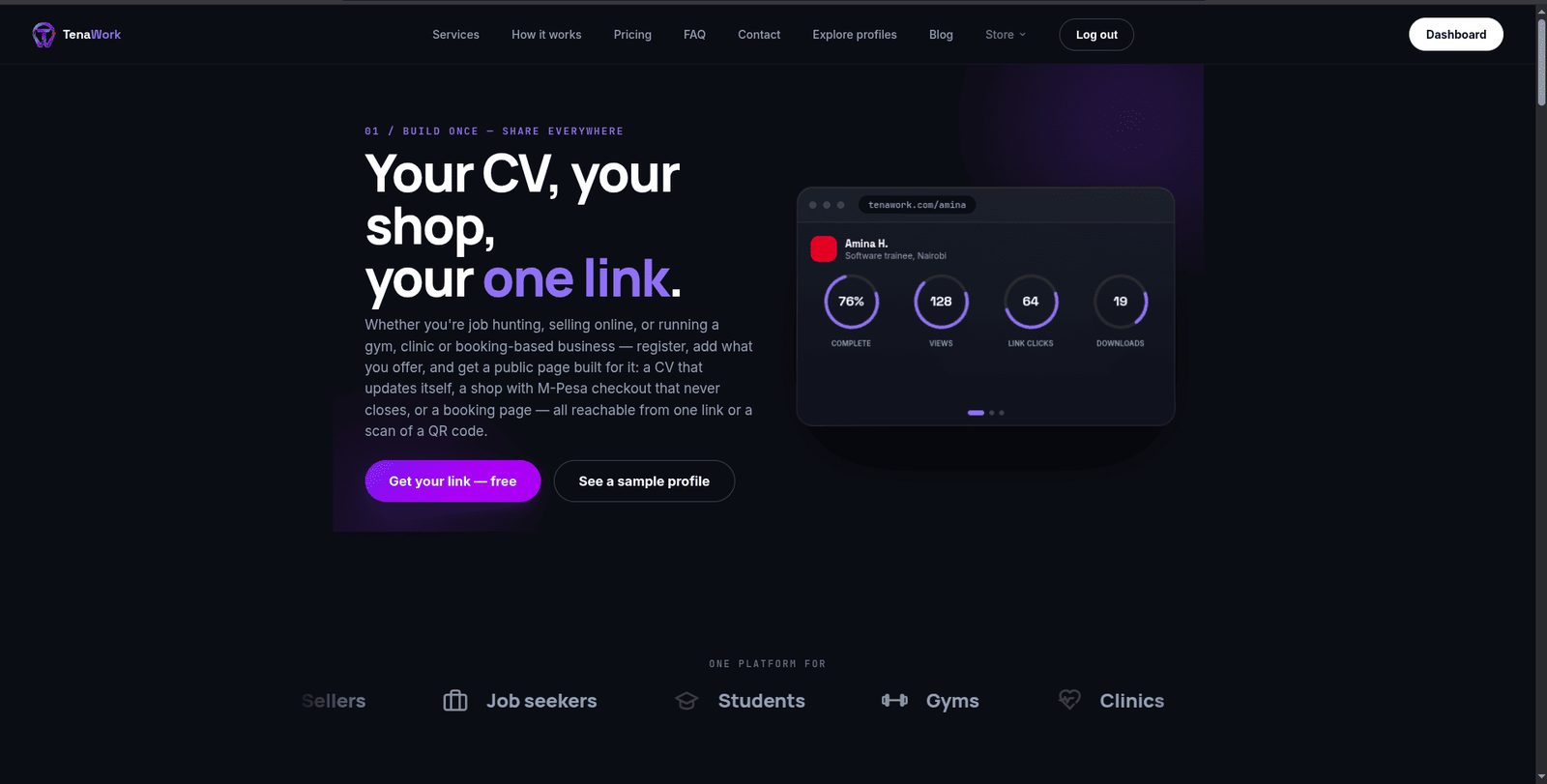
And in a digital-first job market, there is another option: give people a single link to your professional identity.
Instead of sending a static CV that can become outdated, you can share a digital portfolio containing your CV, skills, experience, projects and social links.
That's where a platform like TenaWork can be useful.
You can share one link, and when you update your profile or CV later, the same link can continue pointing to the latest version.
That means you don't have to keep sending a new file every time something changes.
7. Think Beyond the PDF
A PDF is useful, but it is still a snapshot.
You might send your CV today, complete another project next month and gain a new certification later. The person who received your original CV won't automatically see those updates.
A live professional profile gives you another way to present your experience.
You can include your:
- CV
- Skills
- Work experience
- Projects
- Portfolio
- Social links
- Professional contact information
Instead of asking someone to piece your professional story together from different platforms, you can put the important information in one place.
8. Keep the Design Simple
Your CV doesn't need to look like a magazine cover.
Good typography, clear sections, consistent spacing and a logical hierarchy will usually do more for readability than excessive graphics and decorative elements.
Ask yourself:
Can someone understand my experience in a few seconds?
If the answer is yes, the design is doing its job.
If the reader has to figure out where your experience starts, which dates belong to which jobs or where your contact information is, simplify it.
Your CV Should Make the Next Step Easy
The purpose of a CV isn't to tell someone absolutely everything about you.
It's to make the right information easy to understand and give the reader a reason to learn more.
Start with a clear summary. Make your timeline easy to scan. Remove irrelevant information. Highlight skills you can actually demonstrate. Show evidence of your work. And make it easy for someone to reach you.
Then give your professional identity a home that can grow with you.
Create Your Portfolio Today
Build your professional digital identity with TenaWork and put your CV, skills, experience, projects, and social links in one place.